Awestruck in Dali’s Old Town

Dali is so beautiful that it can be downright dangerous.

I was riding a bike through the city’s Old Town, taking in the scenery and historic architecture, but not the giant pothole that lay in front of me. The next thing I saw was concrete.

Fortunately, I landed left knee first, and suffered only a few bruises. I hobbled to a nearby pharmacy and, using broken Chinese and a little point and grimace, described what I needed. I felt embarrassed, but if any Chinese city is going send me head over heels I’m glad it was Dali. Continue reading

Kunming confessions

I’ve been traveling alone in Yunnan province in southwestern China for the past couple of days, which has forced me to speak Chinese pretty much wherever I go.

I’ve made big strides after two years of Chinese lessons, and I’m slowly trying to come out of my shell and be more chatty. This morning, the cab driver who picked me up from the airport in the city of Dali was quite a character. Continue reading

One man’s paradise is another kid’s backyard

My trip to the Philippines couldn’t have come at a better time. Beijing is currently experiencing its coldest winter in 30 years. The chill has been made even worse by a stretch of “crazy bad” air pollution.

On mornings when the smog blocked the sun and pulled a curtain on the horizon, I’d close my eyes and imagine a paradise of blue: blue skies, blue water, a blue frozen drink with sliced mango hanging off the rim. Continue reading

A capital idea? Hardly!

For most of my life, China has been a bit of a mystery.

In primary school, I learned about European royalty, the plight of the Native Americans and the wisdom of Abraham Lincoln. In high school, I had an animated history teacher who worked himself into such a frenzy during lectures that his stories became more like theater. I could close my eyes and, with his vivid descriptions, picture a stumpy Napoleon riding horseback into the teeth of a thousand bullets.

Sadly, Asian history was boiled down to just a few major events: a country that bombed us (Japan, at Pearl Harbor) and a country we bombed the hell out of a couple of decades later to stop the spread of communism (Vietnam). In college, I bought a book about a World War II mission to rescue US and British POWs, including some survivors of the Bataan Death March, from a Japanese camp in the Philippines.

So it wasn’t until I moved to China in 2010 that I began to understand the country’s history. I didn’t even know that Beijing was not always the national capital. In April, I traveled to Nanjing, the seat of power from 1368 to 1420 during the Ming Dynasty and again in the early 20th century, before the Communists “liberated” China in 1949.
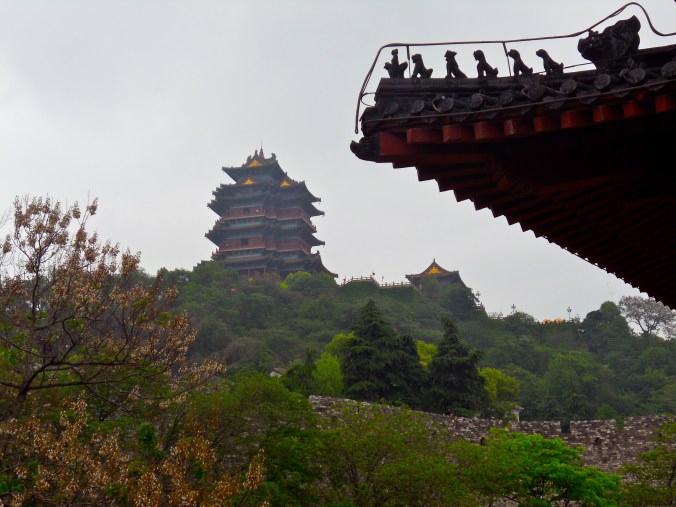
The Jinghai Temple.

A ceiling inside the Jinghai Temple.

The Linggu Pagoda was built in 1929 to honor soldiers who died in a war between the Chinese Nationalists (Kuomintang) and local warlords.

To third Ming emperor Yongle, who moved the capital to Beijing in 1420, I’ve got to ask: Dude, what were you thinking? Beijing doesn’t get much precipitation, so it can be brutally dry. It’s prone to sandstorms in spring, which leave a red film over everything unfortunate enough to be left outdoors. The winters are long and, when the winds whip down from Siberia, bone-chillingly cold. And unlike many major cities in the world, it isn’t located near any large body of water. Continue reading

There’s no space like home

One of the things I miss most about living in a small town is the space: the ability to stretch out my arms without hitting another person or walk for miles without seeing anyone.

It’s a luxury you lose in a city like Beijing, where even the widest streets sometimes feel every bit as cramped as the smallest alleys. The crowds are difficult to avoid, whether you’re riding the subway in the middle of the day or going to the bank on a Saturday. The feeling of constantly cramming into lines and bumping elbows with strangers can become overwhelming.

When I need a break from the crowds, I often head into one of Beijing’s 300 parks. For a city hell-bent on growth and economic development, Beijing has a surprising amount of space committed to leisure and recreation.

The largest is Chaoyang Park. At 713 acres, it is is comparable in size to New York’s Central Park. It’s home to a very unsafe-looking roller coaster (the only thing holding the safety harness down was a seat belt that looked like it had been pulled from a junked car), volleyball courts that were used during the 2008 Olympic games and restrooms that resemble a giant ladybug.

It’s easy to get lost, as I managed to do last summer when I rented a tandem bike with my girlfriend and made the fatal error of letting her lead the way. When we came to the conclusion that neither of us had any idea where we were going, I picked a direction and peddled like a madman to get us back to the rental office before it closed. Despite giving it my all we arrived a few minutes late and had to forfeit the deposit for the bike. Continue reading