An excuse a day keeps the doctor away

I was having dinner with friends one evening when I felt a numbness in my chest. I thought maybe it was from something spicy I had eaten, so I excused myself from the table and walked to the bathroom. I splashed water on my face and paced in the stall, hoping the feeling would go away. But it just got worse, spreading from my chest to my left arm. My hands grew cold and clammy.

I went to the hospital later that night, and found out that my blood pressure was unusually high: 160/90. She asked me to return the following morning for a laboratory tests, including a blood test. I, of course, didn’t go back.

I’ve always felt like I could take care of my health on my own, just by eating properly and getting plenty of exercise. I’m stubborn too, which I inherited from my parents. I’ve watched my mother drag herself into work for a 12-hour shift for the seventh day in a row, when most people would have been bedridden. My father didn’t like to go to the doctor either.

A few weeks before he died when I was 10, we were playing catch in front of our house when I hit accidentally him in the thigh with a baseball. A bruise that should have been the size of a golf ball swelled to the size of a grapefruit. He promised he’d get it checked out but kept putting off making an appointment. He didn’t realize it at the time, but his blood wasn’t clotting like it was supposed to. He finally made an appointment for a Tuesday. He suffered an abdominal aneurysm two days before the scheduled appointment, and died on a Sunday. Continue reading

Fast-food salads and smoothies? I’m not lovin’ it!

USA Today reported last week that Burger King was making a series of changes to its menu in an effort to create a new image. It wanted to offer more healthy options.

“It doesn’t sound like Burger King,” the article said. “There’s a quiet whir of blenders crafting made-to-order smoothies with real strawberry, banana and mango pieces. Nor does it taste like Burger King. Not when one of its three new salads is topped with tangy apple slices and dried cranberries, and covered in an apple cider vinaigrette. You can even get made-to-order frappes.”

The fast-food chain’s home page shows pictures of the new items, but none of the juicy patty of meat for which it is named. Why Burger King wants to reinvent its image is beyond me. Continue reading

There’s no space like home

One of the things I miss most about living in a small town is the space: the ability to stretch out my arms without hitting another person or walk for miles without seeing anyone.

It’s a luxury you lose in a city like Beijing, where even the widest streets sometimes feel every bit as cramped as the smallest alleys. The crowds are difficult to avoid, whether you’re riding the subway in the middle of the day or going to the bank on a Saturday. The feeling of constantly cramming into lines and bumping elbows with strangers can become overwhelming.

When I need a break from the crowds, I often head into one of Beijing’s 300 parks. For a city hell-bent on growth and economic development, Beijing has a surprising amount of space committed to leisure and recreation.

The largest is Chaoyang Park. At 713 acres, it is is comparable in size to New York’s Central Park. It’s home to a very unsafe-looking roller coaster (the only thing holding the safety harness down was a seat belt that looked like it had been pulled from a junked car), volleyball courts that were used during the 2008 Olympic games and restrooms that resemble a giant ladybug.

It’s easy to get lost, as I managed to do last summer when I rented a tandem bike with my girlfriend and made the fatal error of letting her lead the way. When we came to the conclusion that neither of us had any idea where we were going, I picked a direction and peddled like a madman to get us back to the rental office before it closed. Despite giving it my all we arrived a few minutes late and had to forfeit the deposit for the bike. Continue reading

The land of the emperor of beers

Growing up in a part of the world largely isolated from Asian culture, two of the things I associated most with China were fortune cookies and Tsingtao beer.

I quickly found out after eating a couple meals in Beijing that fortune cookies are not a Chinese tradition. But Tsingtao beer is to China what Budweiser is to America: the emperor of beers.

Tsingtao is brewed in Qingdao, a city on China’s east coast, which hosts an international beer festival every year. Since I rarely meet a cold drink I don’t like, I decided to go there last August to mingle with the country’s top beer connoisseurs.

I took a high-speed train from Beijing to Qingdao, a service that was only opened last summer. If you haven’t taken a trip yet on a high-speed train, you should. The ride is comfortable; it’s less bumpy than a jet and more spacious. I’m about 6 feet tall, and I have trouble getting comfortable on long flights between China and the US. But on the four-hour train ride, I could stretch out without digging my knees into the back of the person sitting in front of me.

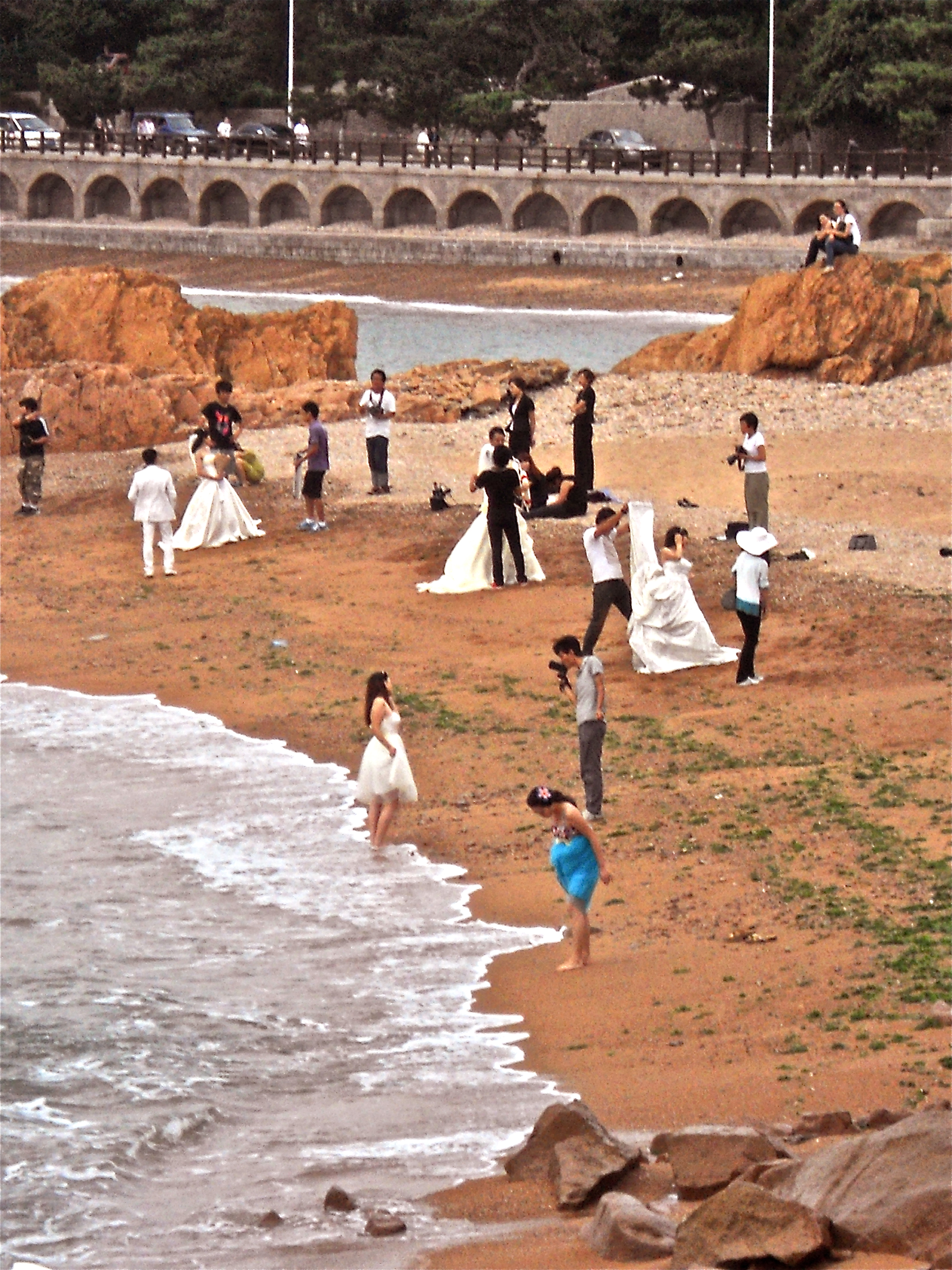
One of the first places I visited in Qingdao was a boardwalk along the shore of the Yellow Sea, on the east coast of China. The sky was overcast, and the beach was dotted with couples posing for pre-wedding pictures — a popular practice among middle- and upper-class Chinese. A light breeze ruffled the brides’ white wedding gowns as the photographers and their assistants scrambled to finish before sunset. The air in Qingdao was clean and fresh and provided a much needed break from the stagnant, gray air I’ve become accustomed to breathing in Beijing.

Boardwalk along the shore of the Yellow Sea. Buildings in downtown Qingdao can be seen in the distance.

Couples and photographers maneuver for the perfect position on one of Qingdao's beaches.

That evening I went to the trip’s main event — the international beer festival. It was held in a huge lot that reminded me of some of the fairgrounds in the United States. A steady rain was falling, and the ground was muddy. Large tents had been set up for the “designated drinkers,” and people crowded inside to stay dry. Many of the tents had stages that featured singers and dancers, turning the beer festival into a sort of variety show. Every so often, a half-loaded man would spring from the audience and join in, drawing cheers from the crowd. Continue reading

Monster tornado carves path close to home

In November 2005, I wrote a story about a helicopter used in medical emergencies.

When I went to take a look at the helicopter, the pilot invited me to go for a ride. “We can go wherever you want,” he said.

“Let’s fly the path of the tornado,” I suggested. Continue reading

Performing America’s toughest job alone

I was riding in the back of a cab on a recent afternoon when the driver looked up and said he had a message for me.

“The 21st century belongs to China,” the man, in his 50s, said in Mandarin. “For every 10 cents we earn, we save 9, that’s why the Chinese were not really affected by the global financial crisis … Foreigners are now coming here to learn how to save money.”

I smiled and kept my mouth shut, as I often do when I’m told that China will pass the United States as the world’s top economy. It’s a common belief these days, not only here but in the rest of the world. The reason? As Bill Clinton would say, “It’s the economy stupid.”

“This is especially the case in Western Europe, where the percentage naming China as the world’s top economic power has increased by double digits in Spain, Germany, Britain and France since 2009,” Richard Wike, associate director of the Pew Research Center’s Global Attitudes Project, said last month in a discussion on US-China public opinion.

A luxury hotel under construction beside the gleaming China Central Television tower in downtown Beijing. Construction projects can be seen in many large cities in China, the world's second-largest economy.

Meanwhile, the Chinese, by almost a 2-to-1 margin, still rate the US as the world’s top economy, Wike said. Continue reading

Fortress opens window to ancient China

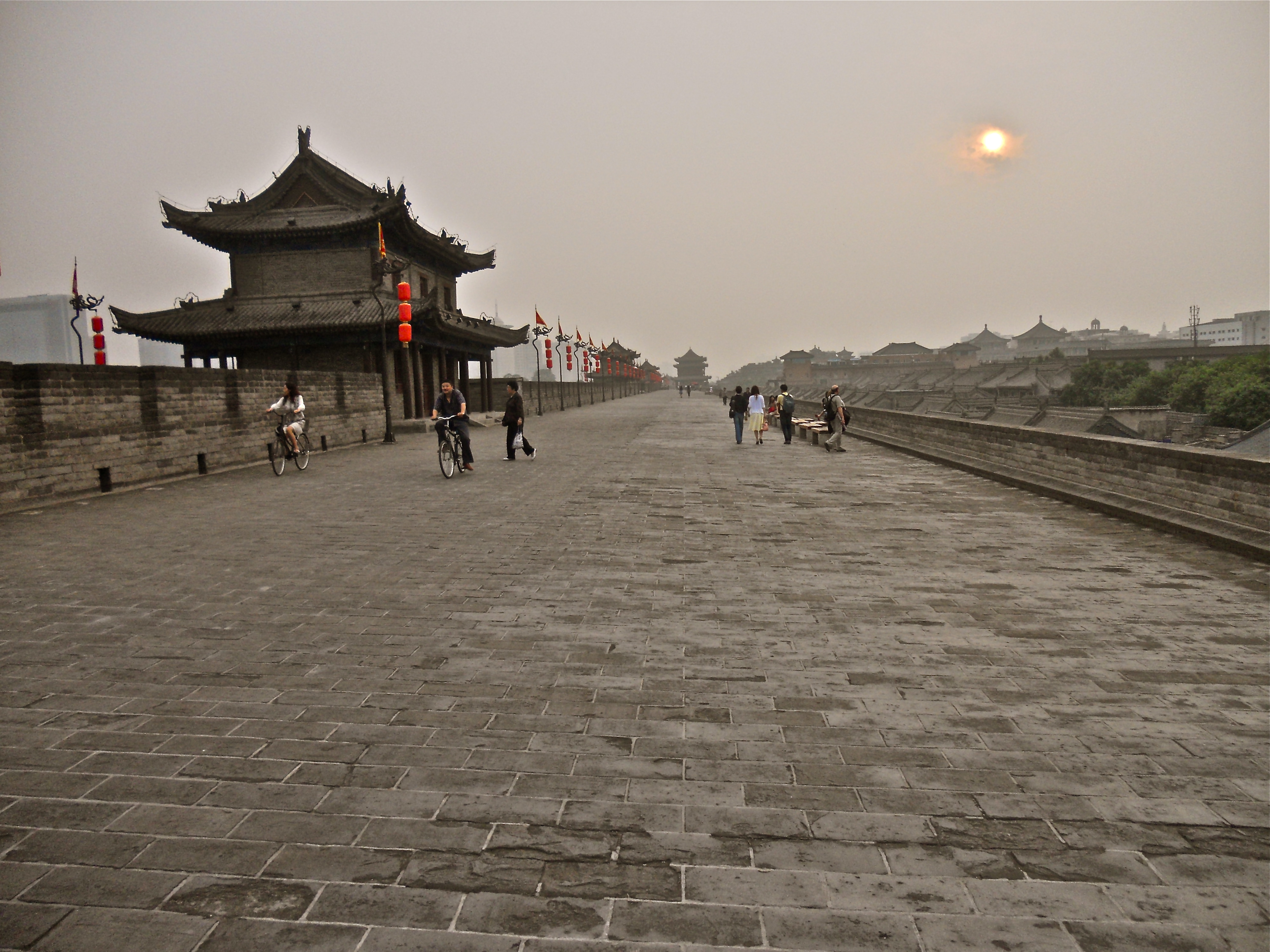
I imagine it got lonely up here at night in the darkness, 12 meters off the ground. It was probably quiet too with the entire city sleeping, and with no cell phones, no radio, no TV. Just a bow and arrow and maybe some food and water to tide you over till the morning.

The sunrise must have been brilliant, with a view extending several kilometers into the countryside. Even the most indecisive minds likely had ample time to make judgments about the intentions of men approaching the gate. Business or battle. Friend or foe.

The towers where the first protectors of Xi’an patrolled in the 14th century are today home to merchants peddling cheap souvenirs and renting bikes to tourists. There is no view of the horizon anymore, thanks to scores of high-rise apartment buildings and air pollution from factories. The silence is gone too, as cars and buses lined bumper-to-bumper rumble through the wall’s gates all hours of the day, entering the heart of a growing city with a population of already 8 million.

A street in the city center that leads to one of the wall's gates.

The wall is now a tourist attraction, one of many sites that draw visitors from around the world to Xi’an, in northwest China’s Shaanxi province. The wall, shaped like a rectangle, surrounds the city center. It was built in 1370, during the Ming Dynasty (1368-1644), and is one of the best preserved ancient walls in China. Continue reading

Survivor’s story of hope continues to echo

Some voices are hard to forget.

I saw a preview recently for a show on the Biography Channel called “I Survived.” The show features people who have survived near-death experiences such as a grizzly bear attack, kidnapping and the Sept. 11, 2001, terrorist attacks on the World Trade Center. The survivors tell their stories without the help of a narrator and against a black background, giving it an intimate one-on-one feel.

One of the women in the clip looked familiar. But I didn’t make the connection until I heard her voice: “I survived that night because I had to live for my daughter.”

I first met Penny in 2006 when I was a reporter for the Evansville Courier & Press, a midsize newspaper in southern Indiana. Normally, I would go out and find people to interview for stories, but Penny found me. When she contacted the newspaper, her call was forwarded to me because I was on the police beat.

Penny told me that she had been raped and left for dead. She was upset at the way the police had treated her during the early parts of the investigation, and she wanted to share her story with the public. It was rare for a victim of a sex crime to want to speak about their case, and our newspaper had a policy of not identifying rape victims to protect their privacy. Continue reading

Fair is foul and foul’s not fair

The walk from my apartment to the closest subway station takes about 10 minutes. I usually try to zone out. There’s not much to look at. Most of Beijing’s neighborhoods are packed with high-rise apartment buildings that clog the skyline, each as forgettable as the next. Mine is no different. Except for the turds.

Dog turds are everywhere. And by everywhere I mean every few yards: one stinking, sticky landmine after another. Worse yet, the same turds often sit on the sidewalk for several days before they’re either washed away or scooped up by street cleaners. I know because I walk the route several times a week.

(Photo courtesy of Erin McCracken)

One day I kept a tally of the turds I passed. In the middle of the sidewalk. On a curb. In front of a school. Outside the entrance of a chicken feet restaurant. By the time I got to 40, I felt like gagging and stopped looking down. Continue reading

Where there’s a Wall, there’s a way

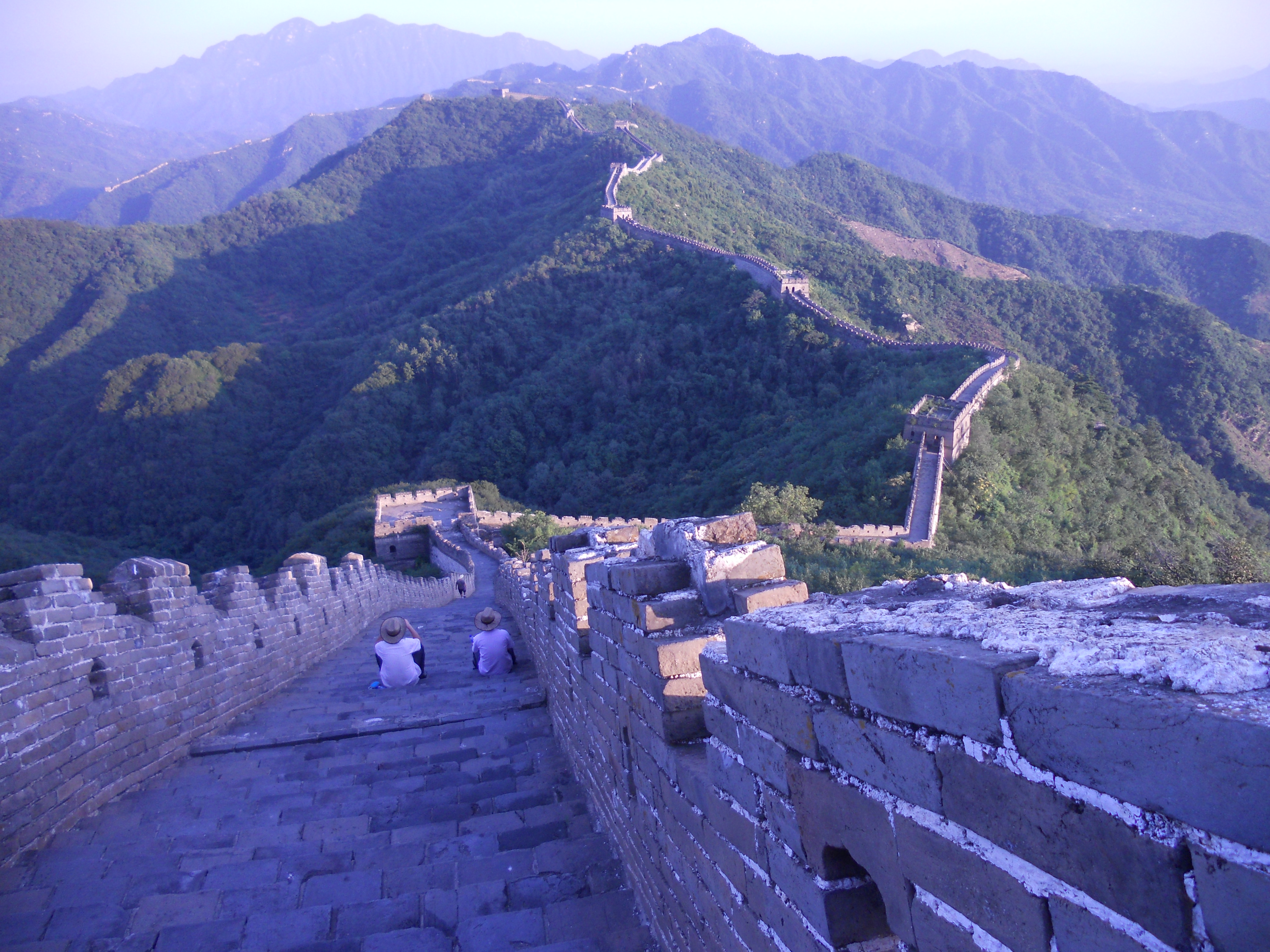
One of the first places I visited after moving to Beijing was the Great Wall at Mutianyu. It sits above a charming village that has benefited greatly from tourism. Group buses from Beijing, only 70 km away, whiz past farmers carrying wood and crops on narrow roads all day long.

The road that leads to the Wall has been taken over on both sides by vendors hawking T-shirts (I climbed the Great Wall!), Chairman Mao hats, poster prints of the Wall and dozens of other souvenirs. There’s even a Subway restaurant, but sadly no McDonald’s or Starbucks. I thought about turning around but kept going.

To get on the Wall you can either walk a steep trail or ride a ski lift. I chose the ski lift and as I waited in line, I walked past pictures of foreign dignitaries who had visited Mutianyu. One of the pictures was of a sweaty Bill Clinton boarding the lift (“Must have been sitting behind some young co-eds,” an American in front of me quipped).

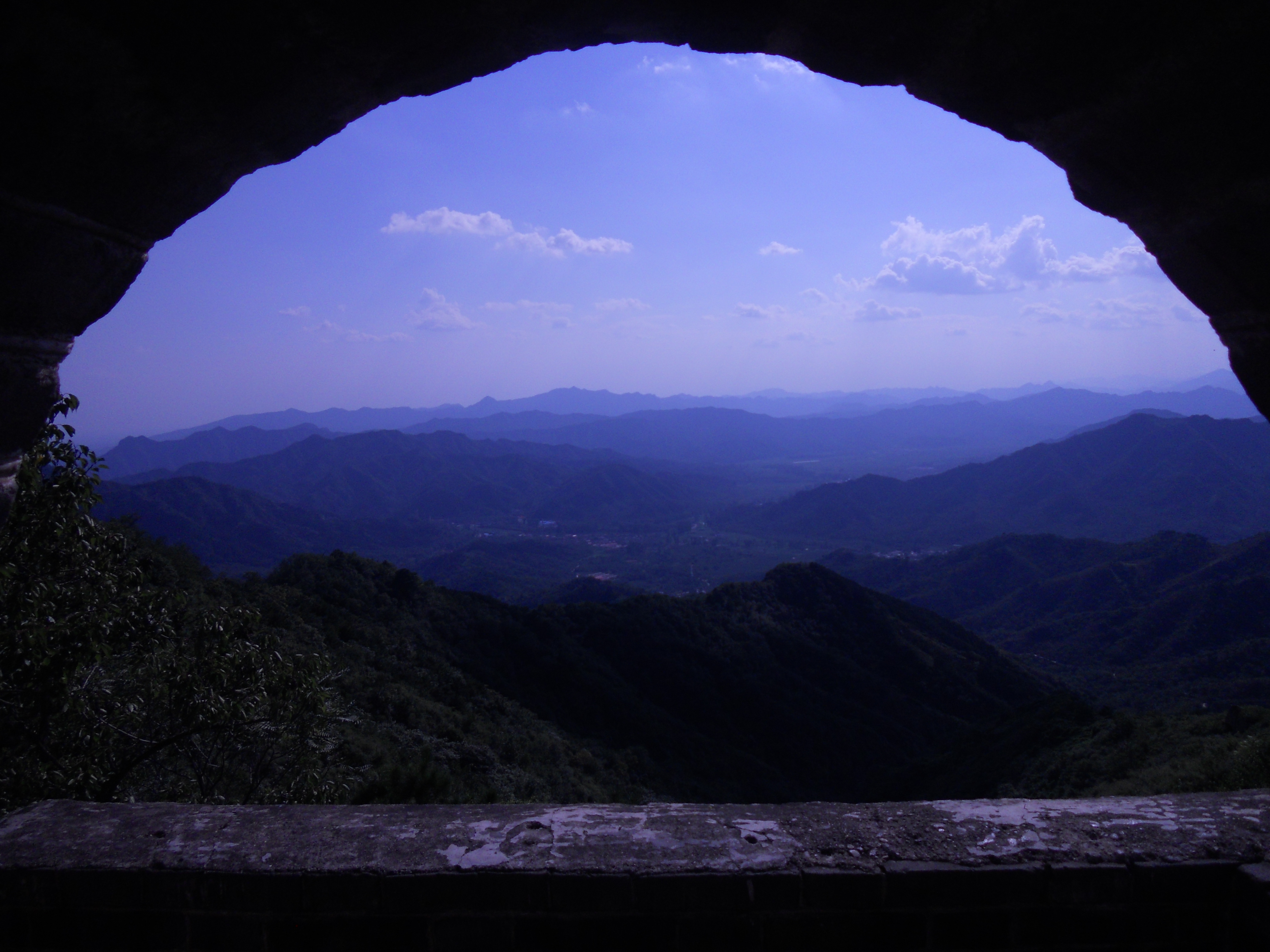
It was a clear day, and the views of the mountains were spectacular. But the Wall, still intact in most places, had a sanitized feel. Many of the towers and bricks at Mutianyu have been restored. I wanted to experience the Great Wall in its natural, crumbling state.

View from a tower window.

Sunset at Mutianyu.

Several months later, I went with three friends to an unrestored section called Huanghua (Yellow Flower). We hired a cab driver named Mr. Li to take us there. Our only request was that he get us to the Wall before dawn so we could take pictures of it at sunrise. Continue reading