A capital idea? Hardly!

For most of my life, China has been a bit of a mystery.

In primary school, I learned about European royalty, the plight of the Native Americans and the wisdom of Abraham Lincoln. In high school, I had an animated history teacher who worked himself into such a frenzy during lectures that his stories became more like theater. I could close my eyes and, with his vivid descriptions, picture a stumpy Napoleon riding horseback into the teeth of a thousand bullets.

Sadly, Asian history was boiled down to just a few major events: a country that bombed us (Japan, at Pearl Harbor) and a country we bombed the hell out of a couple of decades later to stop the spread of communism (Vietnam). In college, I bought a book about a World War II mission to rescue US and British POWs, including some survivors of the Bataan Death March, from a Japanese camp in the Philippines.

So it wasn’t until I moved to China in 2010 that I began to understand the country’s history. I didn’t even know that Beijing was not always the national capital. In April, I traveled to Nanjing, the seat of power from 1368 to 1420 during the Ming Dynasty and again in the early 20th century, before the Communists “liberated” China in 1949.
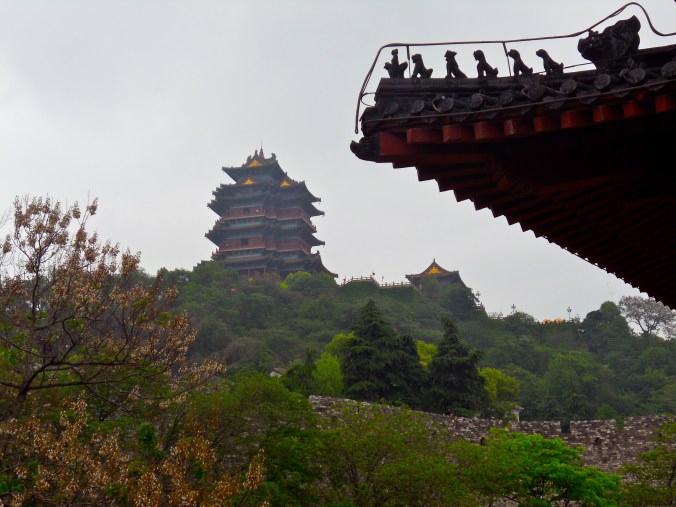
The Jinghai Temple.

A ceiling inside the Jinghai Temple.

The Linggu Pagoda was built in 1929 to honor soldiers who died in a war between the Chinese Nationalists (Kuomintang) and local warlords.

To third Ming emperor Yongle, who moved the capital to Beijing in 1420, I’ve got to ask: Dude, what were you thinking? Beijing doesn’t get much precipitation, so it can be brutally dry. It’s prone to sandstorms in spring, which leave a red film over everything unfortunate enough to be left outdoors. The winters are long and, when the winds whip down from Siberia, bone-chillingly cold. And unlike many major cities in the world, it isn’t located near any large body of water. Continue reading
The hunt for red November

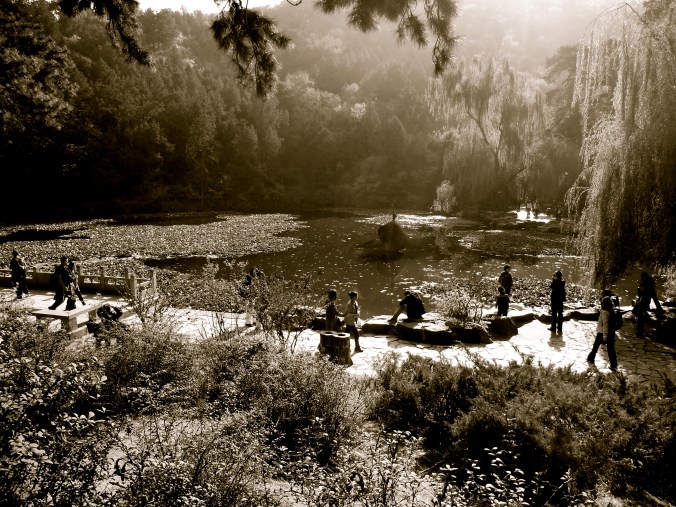
One of the first parks I visited in Beijing was Fragrant Hills (Xiangshan). The park is best known for its smoke trees, which turn the hillside red in autumn.

I went in November, hoping to make a few nice pictures to send to family and friends back home. The climb to the top of the park took about two hours. Along the way I saw plenty of yellow and golden leaves, but no red ones. To make matters worse, when I reached the peak the view of Beijing was obstructed by pollution.

But the hike wasn’t a total loss. On the way down, I found a trail that led to a pond. The surface was covered with leaves and water lilies. I took several pictures, and then climbed to a higher spot so I could get the people walking around the water in the frame. From there I captured one of my favorite images of my first few months in China.

A tale of two sides

Shanghai is a city best seen from above. I recently took in a view from a rooftop bar called Flair, on the 58th floor of the Ritz-Carlton.

The bar was full, but I was able to wedge into a spot overlooking the Oriental Pearl Radio & TV Tower. An array of neon lights from the skyscrapers in Shanghai’s Pudong district – an area that was mainly farmland until it was developed in the 1990s –  gave the clouds moving slowly overhead a yellowish tint.

View from the top of the Ritz-Carlton.

Shaped liked a rocket waiting to blast off into space, the Pearl Tower reminded me of one of the tacky electronic toys that vendors outside the Forbidden City in Beijing use to get your attention as you enter the palace. To the southeast, another behemoth of a building, the 101-story Shanghai World Financial Center – jutted into the sky. Not to be upstaged by the bizarre Pearl Tower, the top of the World Financial Center resembles a bottle opener, with a gap large enough for a modern day King Kong to perch. Continue reading

What, there are traffic laws here?

When I went home to the United States last summer, I couldn’t wait to drive. I don’t own a car in Beijing, and it had been more than a year since I’d been behind the wheel.

I missed that free feeling of an open highway, stereo up and windows down, the smells of summer whipping your face on a moonlit drive through the country. I missed the ability to go anywhere I wanted, at any time of the day, without having to hail a taxi or cram into a subway full of sweaty young men with no sense of personal space. Continue reading

This language is bleatable

Arriving in China for the first time without having ever studied the language is a bit like being shot out of the womb. You can’t speak or read signs, so you’re forced to point and use body language to interact with this strange, new world.

The first time I hailed a taxi in Beijing, I must have reeked of that fresh off the boat smell because the driver immediately began peppering me with questions. He didn’t speak English, and I only understood three Chinese expressions, ni hao (你好, hello) xie xie (谢谢, thank you) and dui (对, correct).

When we came to a red light, he drew the letters U-S-A on the steering wheel and raised his hand, extending his fingers horizontally so his palm was flat like a duck bill. He moved his hand toward me, making a “whiiissshhh” sound as it cut through the air. Continue reading

Father’s Day … Oh, the things we’d share

Father’s Day is one of the few days out of the year that I’m actually glad I live thousands of miles from home.

If I were back in Kentucky, I might drive to Kroger and buy a mismatched bouquet of flowers and take them to a graveyard not too far from where I attended high school. I’d pause before getting out of my car, maybe fiddle with the radio for a minute or two and take a deep breath. I’d probably be alone.

I’d find my father’s grave and stare at it for a while. His first name, David, is my middle name. I’d look at the year of death – 1989 – and think about my life before then. The memories I have are coated in the kind of yellow tint you might find in an Instagram photo. Continue reading

Vanishing into thick air

My biggest complaint about Beijing is the pollution. Nothing saps the energy out of me first thing in the morning quite like looking out the window and not being able to see a building that I could probably hit with a baseball. It’s depressing and bad for my health.

But I put up with it because I live near the heart of a booming metropolis. Public transportation is great. The food is cheap. And, when I need a respite from the congested streets and noisy shopping markets, there are plenty of art museums and well-maintained parks to get lost in.

I recently traveled to Tai’an, in the eastern province of Shandong, to climb one of China’s holiest Buddhist mountains with a friend from college. We left in the morning, on a high-speed train from Beijing’s South Railway Station. A light haze hung over the city. Continue reading

Change I can believe in

A few months after I graduated from college, I moved to Paducah, a small town in western Kentucky, to work for the local newspaper. I didn’t like my first apartment and after a year living there wanted something bigger. I decided to rent the top floor of a two-story house with one of my co-workers.

As I was filling out paperwork for the lease, I noticed the landlord looking at my roommate. He and I were both clean cut, slender and in our 20s. “Now, you’re not one of those fag couples, are you?” asked my landlord, who was probably in his 50s. “They’re practically taking over the neighborhood.”

Our home was in a neighborhood that had been designated as an arts district. Artists who bought property in the area were eligible for sizable grants to make improvements to their home. The project attracted artists from all over the country. And some of them were gay.

We weren’t, but I didn’t feel the need to tell my landlord. If I were gay, would that make me less capable of paying my rent on time? Less trustworthy? Continue reading

Tall, dark and shiny Hong Kong

I used to have dreams in which I would walk to the edge of a cliff and peer down into a seemingly bottomless canyon. Suddenly, a gust of wind would knock me off my feet, and I’d tumble over the side.

Most of the time, I’d catch a branch on the way down and pull myself back up to safety. But sometimes I’d continue falling toward imminent death. In those dreams, the feeling was real, because I was actually falling out of my bed. I’d wake up on the floor with that weak-in-the-knees sensation you get from fear.

I experienced that same feeling while observing Hong Kong’s skyline from the Peak Tower. Located near the top of Victoria Peak, a 552 meter hill overlooking the city, the tower sits 396 meters above sea level. I went at night, on an evening when the sky was clear. I was lucky, because sometimes the pollution from factories on mainland China is so heavy that it casts a haze over the island, considerably reducing visibility of the skyline. Continue reading

In China, a 75-year-old war wound is still bleeding

When I was a boy, I liked to argue with adults about history. I’d ask questions that are impossible to answer, like whether the United States would have become a superpower if the South had won the Civil War, or whether we’d all be speaking a different language if the Allied forces hadn’t defeated Adolf Hitler’s Nazi Germany.

I formed my own opinions too, mostly based on facts I learned at school. One of the more heated debates I had was with my grandfather, a Korean War veteran. I told him I thought the U.S. was wrong to drop atomic bombs on Japan during World War II.

He said the bombing was necessary to end the war, and that I didn’t understand how brutal the Japanese soldiers were. But what about all the innocent people in Nagasaki and Hiroshima killed by the bombs, I asked. What did they do to deserve to die?

It was the only way to end the war, he repeated. Continue reading