Spring, I hardly knew you

The best time of the year to visit Beijing is Spring. The temperatures are comfortable, gusty winds generally keep the skies blue and trees begin to bloom.

Dormant streets come to life, as old men hunker over small tables to watch card games. Vendors pack up their tents and grill barbecue in the open. Children who have been cooped up all winter shed a few layers of clothes and run freely in the warm air.

It sounds romantic, but the truth is Beijing’s Spring is more of an intense fling. That’s because it passes in the blink of an eye. After five months of extreme cold (this winter, which saw the coldest temperatures in Beijing in more than 30 years and long stretches of dangerous air pollution, was especially trying), we get about one month of good weather in May, followed by four months of blazing-hot summer. Continue reading

Small town PRC

By the time the sun set in Anxi, the only noise I could hear outside was the crow of a lone rooster. The streets near the home where I was staying were empty. The skies were dark, lit up only by stars peeking out from the clouds blowing overhead.

It reminded me of home.

I come from a small town in Eastern Kentucky. Small as in population 6,000. Anxi, population 1 million, is a “small” place too, according to the family I stayed with. Continue reading

White male seeking red roses

Finding a flower shop had never been so hard. Then again, this was the first time I’d tried to do it on an island in China.

It was Valentine’s Day, which unfortunately also happens to be my girlfriend’s birthday. I say unfortunate because the stakes are twice as high. Choose a lame gift or a less-than-spectacular restaurant and the consequences are exponentially bad.

We were visiting Gulangyu, a small island off the coast of Xiamen in the southeastern province of Fujian. Gulangyu became a treaty port after the First Opium War (1839-42), and 13 countries — including the US, Spain and Japan — established consulates, churches and businesses. Continue reading

The heart of Ox Street

Many of China’s temples and churches were wrecked during the Cultural Revolution (1966-76), when communist leaders encouraged young students and workers to destroy symbols of “old China.”

Fortunately for preservationists, Beijing’s Niujie Mosque survived. The mosque was built in 996, during the Liao Dynasty (907-1125), and is the oldest temple in the capital. It’s even older than the Forbidden City imperial palace, which began construction in the Ming Dynasty (1368-1644). Continue reading

No gorilla in this mist

I’ve always been fascinated by skyscrapers. At 7, I remember watching King Kong scale the Empire State Building onscreen and wishing I could do the same. Years later, during a trip to New York City, I took an elevator to the top of the World Trade Center and marveled at the helicopters and small planes flying below.

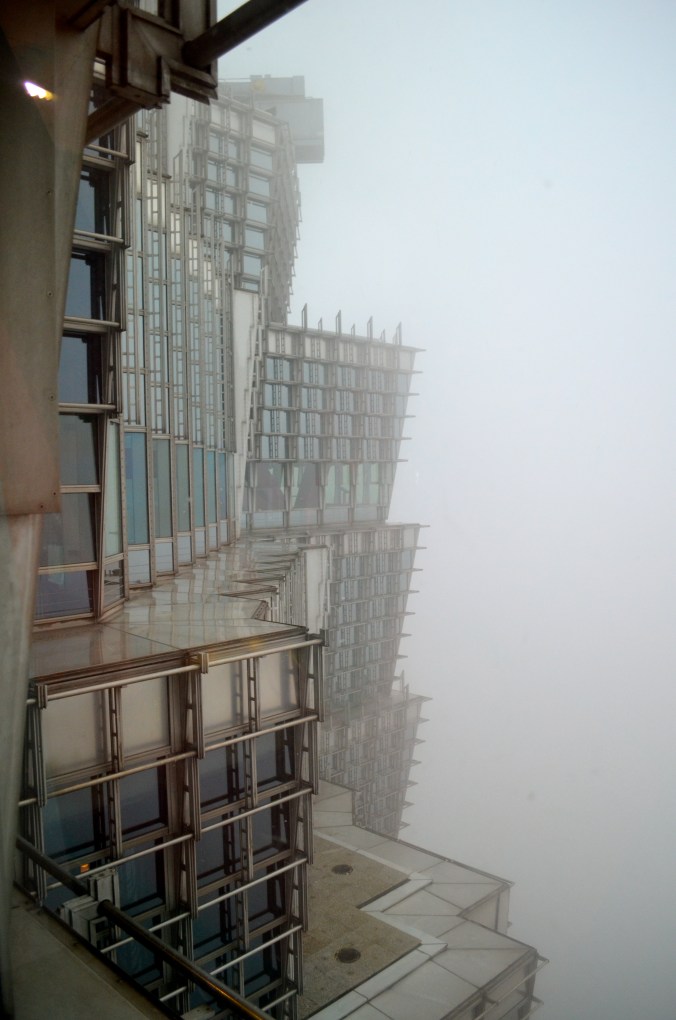
When I visited Shanghai last month, I had to see the city from the top of one of its landmark skyscrapers. I picked the 88-story Jin Mao Tower, home of The Grand Hyatt Shanghai hotel and one of the tallest buildings in China. A sign at the ticket window for the observation deck said “visibility poor,” but I decided to take my chances and paid 150 yuan ($24) for a ride to the top.

It turned out to be the worst 150 yuan I’ve ever spent. Clouds completely obscured the view. With nothing to see, I put down my camera and stared into the mist, wishing King Kong was around to part the clouds.

Looking down into the lobby of the Jin Mao Tower. This turned out to be the best view of the day.

View from the observation deck, looking down into the lobby . This turned out to be the best view of the day.

The 88-story Jin Mao Tower is located next to the (left) Shanghai World Financial Center.

The 88-story Jin Mao Tower is located next to the Shanghai World Financial Center (left).

The only blue skies I saw that day were in the elevator.

The only blue skies I saw that day were in the elevator.

Visibility was less than 100 meters at the top.

Visibility was less than 100 meters at the top.

Smile and say “CT”

Before moving to China in 2010, I had always been a model of good health. Not overweight. Perfect blood pressure. I drank beer and rarely met a pizza I didn’t fall for, but almost always balanced it out with exercise and more than enough sleep.

Something changed in Beijing. Exactly what, I still can’t put my finger on. Dishes here tend to be on the oily and salty side. The air, water and streets are dirty. That can’t help. And I work nights – 5 to 12 most evenings – whereas most of my jobs in the U.S. were day shifts.

Whatever the cause, my body’s changed. My blood pressure runs high, and because of that I feel anxious. I find it harder to relax, and I spend more time worrying about what could be wrong with me instead of thinking about what to cook for dinner or what to buy my girlfriend for her birthday. Continue reading

Not-so-easy rider

There are days that I wake up and can’t stand to look at myself in the mirror.

I think about what I did last night and shake my head. I never thought I’d turn into one of them. The unnecessary risks. The disregard for other people. I’m ashamed of what I’ve become. And yet, when the weekend comes and I inevitably get that itch for a cheap thrill, I’m sure I’ll just do it again.

It’s in my DNA now. I’m a biker. Continue reading

Sweating in style

In the summer of 2010, while taking a stroll around Beijing’s Chaoyang Park, I saw dozens of couples posing for wedding pictures. The skies were clear, and it was sweltering hot. I’m guessing it was around 95 degrees. The men were sweating through their tuxedos, and the women were having trouble keeping their hairdos in place. Continue reading

North Korea’s Kim: Too sexy to be true?

The death of North Korea’s Supreme Leader Kim Jong-il last December set off a period of mourning unlike anything I had ever seen.

The footage broadcast by the country’s state-run media showed tens of thousands of people in the capital Pyongyang, weeping and buckling over in grief. Women fainted, and even grown men sobbed uncontrollably. A New Year editorial published by the North’s leading newspapers called Kim’s death “the greatest loss our nation had suffered in its 5,000-year-long history and the bitterest grief our Party and people had experienced … The tears our service personnel and people shed with greatest sorrow were tears of the unity, unaffected and crystal-clear, and tears of their firm determination to follow the Party to the end of the earth.”

A few days after Kim’s death, I met with my Chinese teacher Cathy for our twice-a-week language lesson. Cathy is in her mid-40s and has lived in Beijing her entire life. Some days we choose a topic to discuss, and on this day we decided to talk about international news.

“What do you think about Kim Jong-il’s death?” I asked. Continue reading

A jade burial suit? Are you crazy?

The day after my paternal grandmother died, I went to a funeral home with my uncles Jim and Paul to pick out a casket.

The director of the funeral home met us at the entrance and said he was sorry for our loss. We followed him to a brightly lit room, where around a half-dozen caskets were on display.

“This is one of our basic models,” the funeral director said, pointing to a casket with an oak finish. If we wanted to go with something “a little more expensive,” he suggested a coffin with a shiny white exterior that resembled marble.

Not even the most basic casket seemed appropriate for my grandmother. Aesthetically speaking, she was a woman of simple tastes.

“$2,000 for a casket? Are you crazy?” I could imagine her saying. “Bury me in a cardboard box, and use the money to buy Jimmy a new coat for winter!” Continue reading