No gorilla in this mist

I’ve always been fascinated by skyscrapers. At 7, I remember watching King Kong scale the Empire State Building onscreen and wishing I could do the same. Years later, during a trip to New York City, I took an elevator to the top of the World Trade Center and marveled at the helicopters and small planes flying below.

When I visited Shanghai last month, I had to see the city from the top of one of its landmark skyscrapers. I picked the 88-story Jin Mao Tower, home of The Grand Hyatt Shanghai hotel and one of the tallest buildings in China. A sign at the ticket window for the observation deck said “visibility poor,” but I decided to take my chances and paid 150 yuan ($24) for a ride to the top.

It turned out to be the worst 150 yuan I’ve ever spent. Clouds completely obscured the view. With nothing to see, I put down my camera and stared into the mist, wishing King Kong was around to part the clouds.

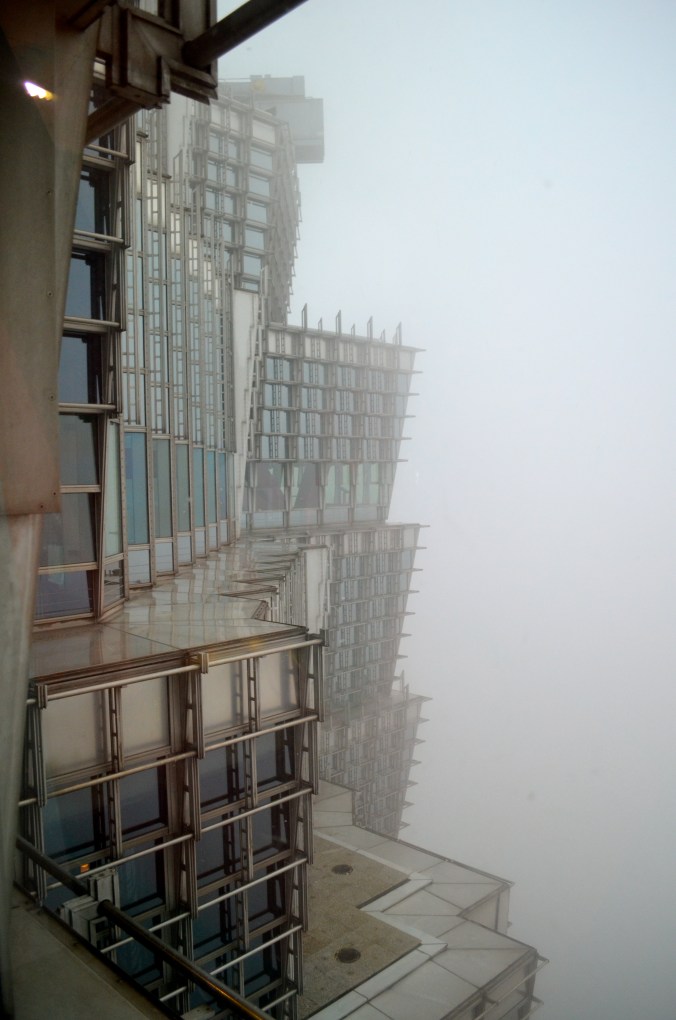
Looking down into the lobby of the Jin Mao Tower. This turned out to be the best view of the day.

View from the observation deck, looking down into the lobby . This turned out to be the best view of the day.

The 88-story Jin Mao Tower is located next to the (left) Shanghai World Financial Center.

The 88-story Jin Mao Tower is located next to the Shanghai World Financial Center (left).

The only blue skies I saw that day were in the elevator.
The only blue skies I saw that day were in the elevator.

Visibility was less than 100 meters at the top.

Visibility was less than 100 meters at the top.

Smile and say “CT”

Before moving to China in 2010, I had always been a model of good health. Not overweight. Perfect blood pressure. I drank beer and rarely met a pizza I didn’t fall for, but almost always balanced it out with exercise and more than enough sleep.

Something changed in Beijing. Exactly what, I still can’t put my finger on. Dishes here tend to be on the oily and salty side. The air, water and streets are dirty. That can’t help. And I work nights – 5 to 12 most evenings – whereas most of my jobs in the U.S. were day shifts.

Whatever the cause, my body’s changed. My blood pressure runs high, and because of that I feel anxious. I find it harder to relax, and I spend more time worrying about what could be wrong with me instead of thinking about what to cook for dinner or what to buy my girlfriend for her birthday. Continue reading

Not-so-easy rider

There are days that I wake up and can’t stand to look at myself in the mirror.

I think about what I did last night and shake my head. I never thought I’d turn into one of them. The unnecessary risks. The disregard for other people. I’m ashamed of what I’ve become. And yet, when the weekend comes and I inevitably get that itch for a cheap thrill, I’m sure I’ll just do it again.

It’s in my DNA now. I’m a biker. Continue reading

Sweating in style

In the summer of 2010, while taking a stroll around Beijing’s Chaoyang Park, I saw dozens of couples posing for wedding pictures. The skies were clear, and it was sweltering hot. I’m guessing it was around 95 degrees. The men were sweating through their tuxedos, and the women were having trouble keeping their hairdos in place. Continue reading

Even the blue, blue grass of home isn’t idyllic

The Chinese characters for America are 美国 (meiguo), which literally mean “beautiful country.”

Whoever came up with this translation knew what they were talking about. After spending more than 14 months in Beijing, every day in my hometown of Morehead, Kentucky, feels like one of those dreamy scenes from a Claude Monet painting. Dark green grass. Rolling hills. Sunsets you can get lost in.

I took all these things for granted when I lived here. People would ask me about my hometown and I’d usually say something like, “It’s small, has only one McDonald’s and nowhere to shop.” I talked a lot about the things Morehead didn’t have, which – I now realize – is what makes it great. Continue reading

Translations gone wild

When I visit the United States on Friday, there will be a lot of things I won’t miss about Beijing: the air pollution, traffic jams and kids taking a dump on the sidewalk, just to name a few.

But one thing I will certainly miss are the Chinglish signs. There have been days when – after failing to accomplish the simplest of tasks because of my limited Chinese – I’ve felt like swearing off chopsticks, grabbing my passport and catching the first plane out of town.

But when I look up and see a sign for dried fruit that says “fuck fruit,” suddenly the clouds part, birds chirp and all is well. (“Dry” and a colloquialism for “sex” share the same Chinese character.) Continue reading

Sometimes I get the red, white and blues

On June 12, the US Embassy in Beijing sent out an e-mail warning Americans to be careful at nightclubs in Beijing. It said that an embassy employee was attacked by a group of Chinese on June 9 at a club near Workers Stadium, a popular bar area and expat hangout.

“The employee, who was out with some colleagues, was hit in the head with a sharp object as he was dancing away from the group,” the e-mail said. “According to witnesses, the employee fell to the floor and was repeatedly beaten and kicked in the head by individuals serving as bouncers for the nightclub. By all accounts, the attack was unprovoked.”

Workers Stadium in Beijing. The US Embassy said one of their employees was attacked at a nightclub on the west side of the stadium. (Photo by Jason Walsh via Wikipedia)

The attack wasn’t the first targeting US citizens, the embassy said, adding that “maintaining an awareness of your surroundings and keeping a low profile are critical to avoiding potential problems.”

Asking a foreigner in Beijing – especially those who look and sound very different from the Chinese – to keep a low profile is a bit like asking a cricket marching in a pack of ants to blend in. It’s just not going to happen. Foreigners make up less than 1 percent of the city’s 20 million residents. We stand out wherever we go. Sometimes that’s a good thing, and sometimes it’s not. Continue reading

It’s a bird, it’s a plane, it’s an American!

One of the few memories I have of first grade is the time I pissed my pants.

School usually let out around 3 pm. It was around 2:45, and I thought I could hold it for another 15 minutes. I crossed my legs and shifted in my seat, trying to focus on anything but the obvious. When the bell rang, I stood up and the floodgates opened.

I was wearing stonewashed jeans with white specks, not the kind of pants that could hide a stain.

My mother was parked outside, and to get to her car I had to walk across a field that separated the school from a road where parents waited for their children. It was the longest 100 yards of my childhood. Continue reading

A capital idea? Hardly!

For most of my life, China has been a bit of a mystery.

In primary school, I learned about European royalty, the plight of the Native Americans and the wisdom of Abraham Lincoln. In high school, I had an animated history teacher who worked himself into such a frenzy during lectures that his stories became more like theater. I could close my eyes and, with his vivid descriptions, picture a stumpy Napoleon riding horseback into the teeth of a thousand bullets.

Sadly, Asian history was boiled down to just a few major events: a country that bombed us (Japan, at Pearl Harbor) and a country we bombed the hell out of a couple of decades later to stop the spread of communism (Vietnam). In college, I bought a book about a World War II mission to rescue US and British POWs, including some survivors of the Bataan Death March, from a Japanese camp in the Philippines.

So it wasn’t until I moved to China in 2010 that I began to understand the country’s history. I didn’t even know that Beijing was not always the national capital. In April, I traveled to Nanjing, the seat of power from 1368 to 1420 during the Ming Dynasty and again in the early 20th century, before the Communists “liberated” China in 1949.

The Jinghai Temple.

A ceiling inside the Jinghai Temple.

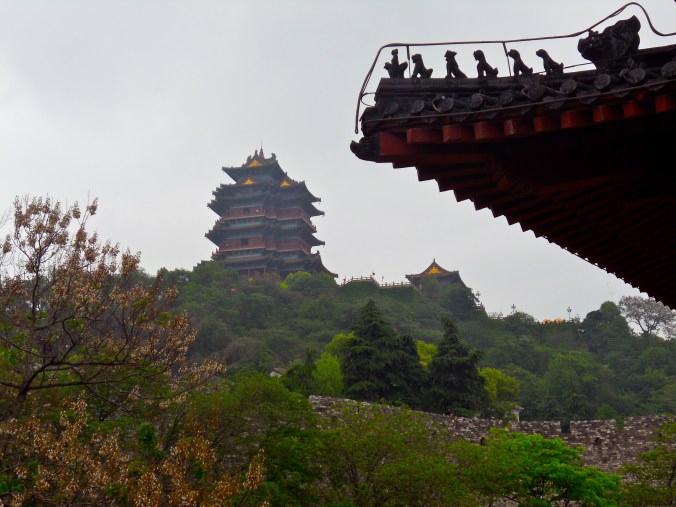
The Linggu Pagoda was built in 1929 to honor soldiers who died in a war between the Chinese Nationalists (Kuomintang) and local warlords.

To third Ming emperor Yongle, who moved the capital to Beijing in 1420, I’ve got to ask: Dude, what were you thinking? Beijing doesn’t get much precipitation, so it can be brutally dry. It’s prone to sandstorms in spring, which leave a red film over everything unfortunate enough to be left outdoors. The winters are long and, when the winds whip down from Siberia, bone-chillingly cold. And unlike many major cities in the world, it isn’t located near any large body of water. Continue reading

The hunt for red November

One of the first parks I visited in Beijing was Fragrant Hills (Xiangshan). The park is best known for its smoke trees, which turn the hillside red in autumn.

I went in November, hoping to make a few nice pictures to send to family and friends back home. The climb to the top of the park took about two hours. Along the way I saw plenty of yellow and golden leaves, but no red ones. To make matters worse, when I reached the peak the view of Beijing was obstructed by pollution.

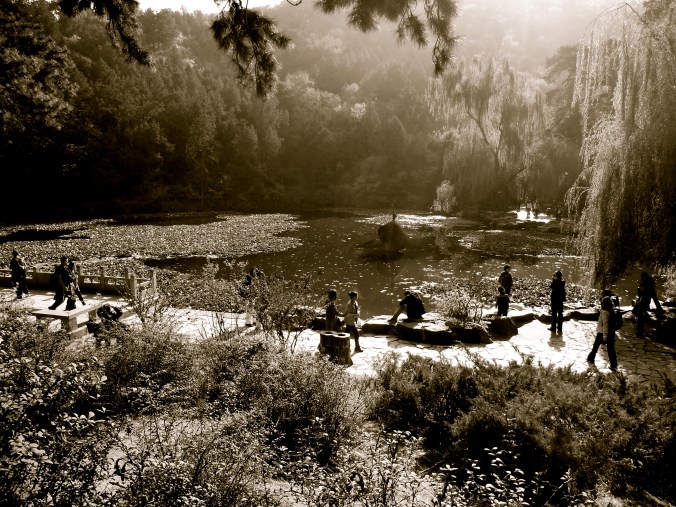
But the hike wasn’t a total loss. On the way down, I found a trail that led to a pond. The surface was covered with leaves and water lilies. I took several pictures, and then climbed to a higher spot so I could get the people walking around the water in the frame. From there I captured one of my favorite images of my first few months in China.